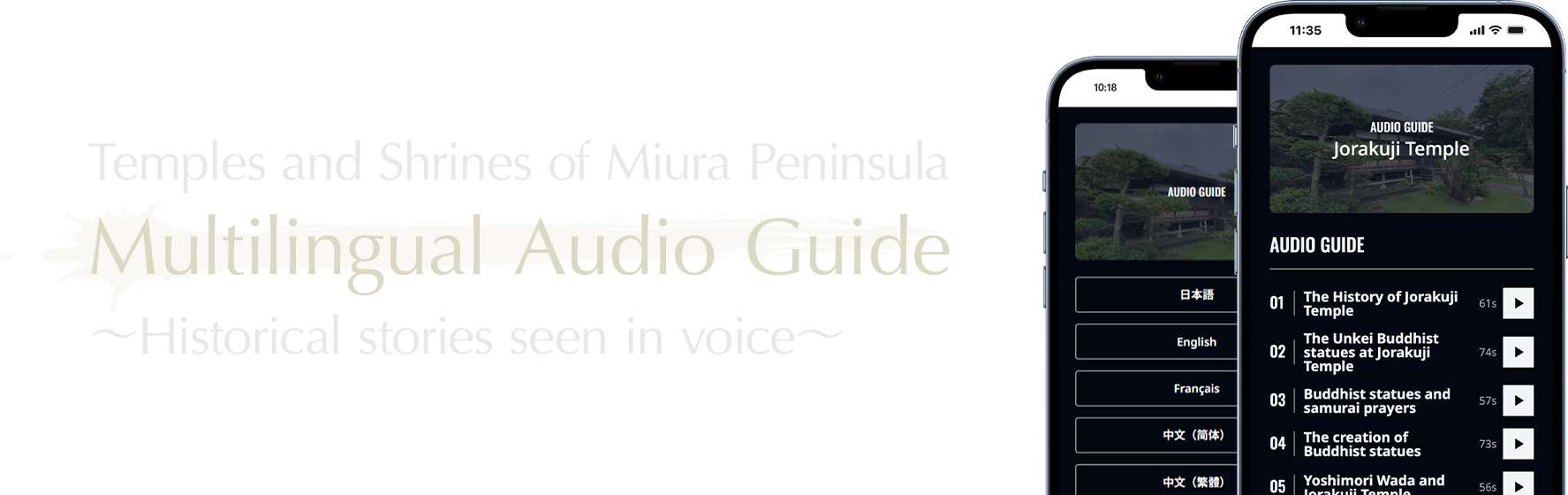
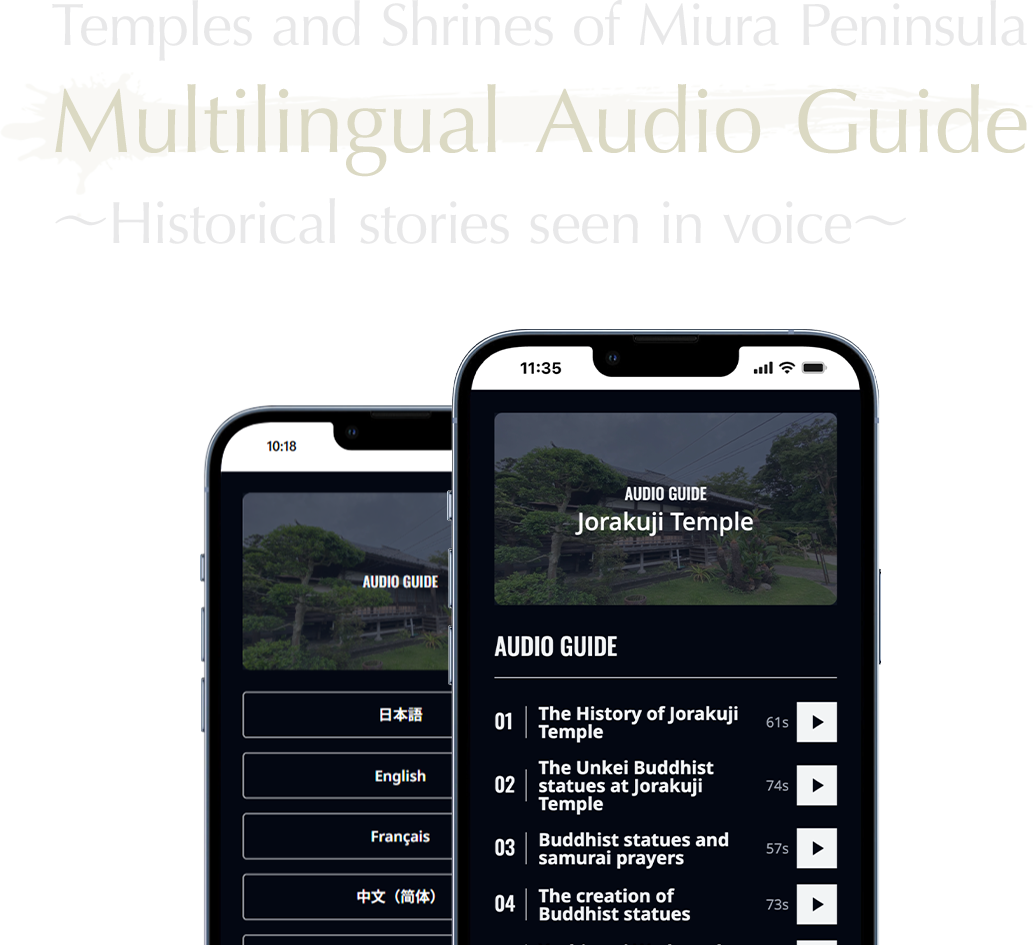
Make Shrine and Temple Tours More Fun: Multilingual Audio Guide App ~History Stories Seen Through Voice~

AUDIO GUIDE ENJOYMENT

Enjoyment of Audio Guides

1

Enjoy 800 Years of Samurai Culture

From the establishment of the Kamakura Shogunate to the end of the Edo period and Meiji era, spanning 800 years. The Miura Peninsula is a holy land for samurai where samurai culture remains strong. Please enjoy the traces of this long samurai history.

2

Easy-to-Understand Historical Explanations

The audio guide allows you to listen to stories about the history and cultural properties of shrines and temples, based on the background of the location.

3

Multilingual Support with AI Narration

You can enjoy the guide not only in Japanese but also in English, Chinese, French, and Korean.

EXPLORE TEMPLES & SHRINES

Shrines and Temples to Experience

Komyoji Temple

Komyoji is one of the principal temples of the Jōdo (Pure Land) sect of Buddhism, founded in 1243 during the Kamakura period. It was established by Hōjō Tsunetoki, the fourth regent (shikken) of the Kamakura shogunate, together with its founding abbot, Ryōchū Shōnin, who is regarded as the third patriarch of the Jōdo sect. The temple is also the birthplace of the Jūya Hōyō (Ten-Night Memorial Services), an important ritual in the Jōdo tradition. Komyoji preserves the legend of the Taima Mandala, a miraculous mandala said to have been woven overnight by a celestial being. Other notable highlights include the largest temple gate in Kamakura, the Great Hall, currently undergoing the Reiwa-era Grand Restoration, as well as the garden and the Daiseikaku Hall.

Jokomyoji Temple

Jokomyoji is a Kamakura-period temple founded around 1251 by the monk Shinna Oshō, with patronage from Hōjō Tokiyori, the fifth regent of the Kamakura shogunate, and Hōjō Nagatoki, the sixth regent. The temple is renowned for its Buddhist statues adorned with decorative techniques unique to medieval Kamakura. Notable highlights include one of the largest stone five-ring pagodas (gorintō) in Japan, the grave of the poet Reizei Tamezane, and—most intriguingly—the graves of successive chief Shinto priests of Tsurugaoka Hachimangū, an unusual and revealing feature for a Buddhist temple.

Jochiji Temple

The Zen Buddhist temple Jochiji was founded around 1281 and is ranked fourth among the Five Great Zen Temples of Kamakura. Its grounds are designated a National Historic Site, and both the bell tower gate and the main hall are notable for their Song-dynasty–style architecture. Within the precincts are Kanronoi, also known as the Sweet Dew Well, one of Kamakura’s famous natural springs, as well as a stone drum bridge, stone steps leading into the temple grounds, and a garden dotted with historic structures that convey Kamakura’s long history. Together, these features evoke the refined and timeless atmosphere of Kamakura as an ancient capital.

Jorakuji Temple

The history of Jorakuji Temple spans approximately 830 years. Of note, are five Kamakura era Buddhist statues created by the renowned sculptor Unkei. Commissioned by the warrior Wada Yoshimori and his wife, they were completed in 1189. The principal statues are the Amida Triad, along with the powerful and fearsome figures of Fudō Myōō and Bishamonten. All five are designated Important Cultural Properties of Japan.

Manganji Temple

Manganji was founded as a large monastic training temple and is closely associated with the renowned Miura samurai clan. Once believed to be the family temple (bodaiji) of Sahara Yoshitsura, the youngest son of the great warrior Miura Yoshimei, recent research suggests that it may instead have been established by Minamoto no Yoritomo as a place of homage to the Miura clan as a whole. Among Mangan-ji’s highlights are a Pure Land–style garden and an elegant Zen dry landscape (karesansui) garden. The temple also houses several statues designated as Important Cultural Properties of Japan, including a Kannon Bodhisattva statue over 2.4 meters in height, as well as statues of Jizō Bodhisattva, Fudō Myōō, and Bishamonten. In addition, more than 2,000 roof tiles from the Kamakura period have been excavated on the temple grounds, attesting to its former scale and importance.

Manshoji Temple

Manshoji is a Zen temple of the Rinzai sect, established in 1194 by the great samurai Minamoto no Yoritomo to pray for the repose of Miura Yoshimei, a patriarch of the Miura clan who distinguished himself in the military campaigns against the powerful Taira clan. The temple’s treasure hall enshrines a seated statue of Miura Yoshimei, a sacred object of worship designated as an Important Cultural Property of Japan. The grounds also include a Shinto shrine known as Goryō-sha, as well as two stone pagodas—a hōkyōintō and a gorintō—believed to mark the graves of Yoshimei and his wife. Another highlight is the azaleas in front of the main hall, traditionally said to have been planted by Yoritomo himself.

HOW TO APPLY

How to Apply

Free Trial Experience

Please access via QR code or the specified URL on your smartphone. Select your language from Japanese, English, Chinese, French, or Korean, and listen to the free audio guide.

Apply for Paid Version

If you would like to use the paid version after listening to the free audio guide, please apply at each facility. You can listen to stories related to the background of the place.

HOW TO USE

How to Use

1

Scan QR Code on Site

Please use your own smartphone.

2

Select Language and Start Guide

Choose your preferred language
and get ready to enjoy
the guide.

3

Play Audio Guide at Each Spot

Learn deeply about history and culture
with the audio guide.

HIGHLIGHTS

App Features

Multilingual Support

Audio guides available in Japanese, English, French, Chinese (2 types), and Korean.

AI Voice Generation

We have prepared high-quality audio guides using the latest generative AI technology.

On-site Access

You can use the audio guide directly from your own smartphone at the site.

For facilities considering
introducing the audio guide, click here

ABOUT US

About the Service Provider
BUSHIDO Cultural Association Logo

General Incorporated Association BUSHIDO Cultural Association

We are working to pass on the samurai culture that has lasted for over 800 years to the next generation, based in the Miura Peninsula.

We have developed this audio guide service to provide more people with an interest in the region's historical and cultural heritage.

We aim to promote cultural exchange connecting local shrines, temples, and cultural properties with visitors, and to share the value of local history and culture with various people.

To all considering
introducing the audio guide

Why not bring out
the new charm of
shrines, temples, and cultural properties
with an audio guide?